.
The First Credible Theory of Cognitive Neuroscience?
Resolving the Mind/Brain/Behavior/Enigma
Eugene B. Shea
________________________________________________________
The human mind has an ‘inhibitory system’ which
routinely and automatically removes from perception,
reason, and judgment over 99% of available fact.”
Jerome S. Bruner (1915-2016)
Précis:
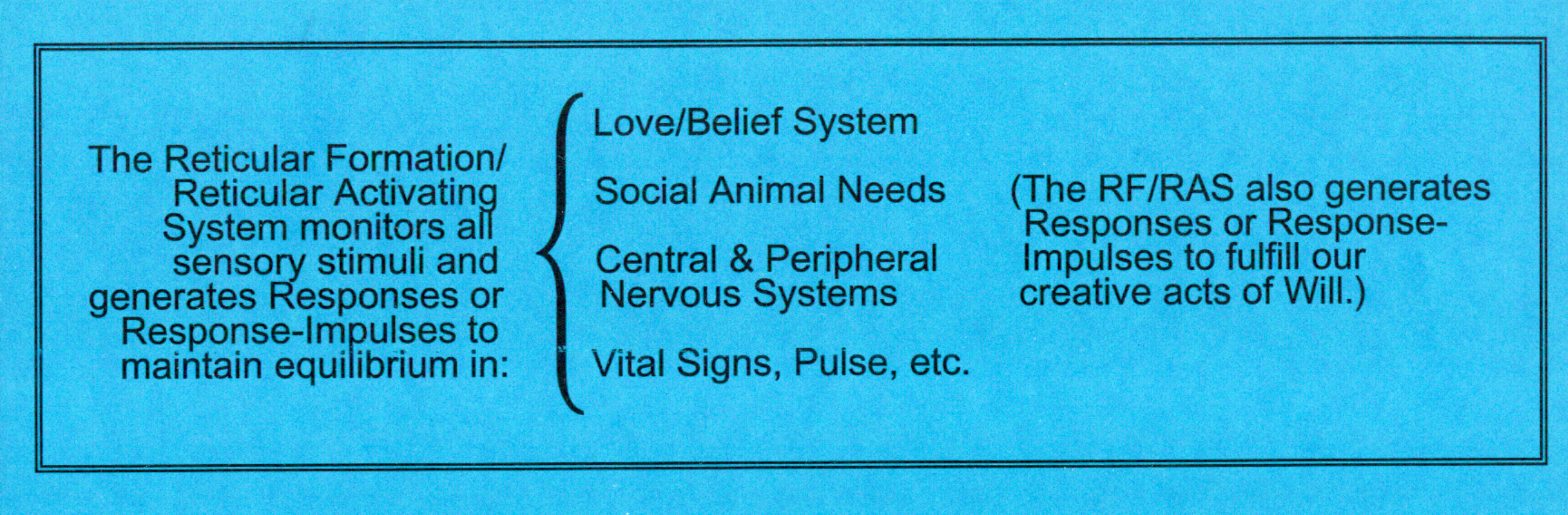
Everything one knows began as a selection of a small group of cognitive impulses from the body, the environment, memories, and conscious and subconscious elements of each of our usually inchoate Love/Belief Systems─all received by the Reticular Formation (RF), a small bundle of nerves at the top of the brain stem, which at a rate of 100,000,000 impulses a second has 24/7, by unknown means, selected those most important to the individual. This selection is projected to the thalamus and hypothalamus, locus of the long-known but disregarded Reticular Activating System. With afferent and efferent connections to the entire brain and body, RAS, identifies and with deference to Love/Belief System elements─perceptual defenses, inhibitions, repressions, etc.─ interprets the data, before reaching consciousness. The laundered data accompanied by relevant response-impulse(s), which if benign, unopposed or conditioned will be executed; or will vie for execution, which only humans with newly defined inherent transcendent needs and faculties, can review and execute, veto, or alter.We each live in our own unique world, which we see, hear, read, and understand through our Love/Belief Systems, or what Christians know as our Hearts.
We are living in a post-hypnotic trance,
induced in early infancy.
R. D. Laing
______________________________________________________________All neuroscience is based on the paradigm of a modular brain, each component independently responsible for, or participating in each brain function—with only one stellar but completely neglected explanation of how they do work together in coordinated responses. it is also based on the paradigm of ‘neuronal man’―the conviction that all human capabilities will eventually be understood in neuronal terms.
Based on these paradigms, neuroscientists have made great strides in mapping the brain and diagnosing and treating biological and mental illnesses.
But neuropsychologists and cognitive neuroscientists, seeking a resolution of the mind/brain/behavior enigma while adhering to these paradigms are having a much tougher time of it. Cognitive neurology was launched with great expectations and fanfare about 50 years ago, and now, after spending billions of dollars and hours in elaborate ‘brain labs’ in prestigious colleges and universities around the world, is still at the starting gate. The American Psychological Association Division for Behavioral Neuroscience and Comparative Psychology is admittedly ‘dying.’
I will present an accumulation of problems with the modular brain and purely neuronal models which have prevented neuropsychology research from even getting off the ground, and to be derisively described as merely “the expensive branch of philosophy.” Cognitive neuroscience has become an oxymoron.I will argue that since our DNA has been shown to be 98+% identical to that of the chimpanzee, which after millions of years is still living in trees; and recently 99.7% identical to Neanderthal man, after 200-300,000 years still living in caves with one tool, a sharpened stone, when they became extinct, that our brains are functionally identical to theirs.
This revolutionary new theory, with doctoral appraisals of “.. a cogent and intellectually impeccable analysis,” and "It is great ... a breakthrough of insight and a comprehensive unification of the relevant sciences," will present a decades-long researched contradistinction of both neuronal man and the modular brain.
With Dr. Dean Wooldridge’s stellar application of biological, neurological, cybernetic, and computer sciences in unraveling brain processes, you will find compelling proof that the brain is managed coherently by the long-known, but completely neglected, Reticular Activating System (RAS), including its ‘sentinel’ and ‘lieutenant,’ the Reticular Formation (RF).
The Reticular Activating System, with its locus in the thalamus and hypothalamus, is a vast network of neuronal afferent and efferent connections to the entire brain and body. Thus it is the perfect candidate for the brain’s Command and Control System―the de facto manager and coordinator of all brain functions. I will present substantial evidence that RAS is dedicated 24/7 365 to maintaining homeostasis in all human biological, socio-biological, physiological, environmental, psychological, emotional, and volitional states.
Finally, I will integrate the coherent brain with phenomenological evidence of the existence, needs and faculties of a uniquely human 'Agent' responsible for our differences with our DNA cousins, yielding an understanding of the full bio/psycho/spiritual nature of man, the genesis of our motivations, behavior, and most psychopathologies, and a resolution of the mind/brain/behavior enigma.
Here is only the first, but one of the best evidences of the coherent brain:
Gatekeeper to consciousness, spark of the mind,
the reticular formation connects with major nerves
in the spinal column and brain. It sorts the 100 million
impulses that assault the brain each second, deflecting
the trivial, letting the vital through to alert the mind. The
mind cannot function without this catalytic bundle of cells.
Damage to them results in coma—the loss of consciousness.
THE BRAIN - MYSTERY OF MATTER AND MIND
U. S. News Books - 1981Although this rendering points to the Reticular Activating System it does not make clear that the Reticular Formation to which it refers, is just a small bundle of unique neurons at the top of the brainstem, within the System. Also it shows only the Ascending Reticular Activating System (ARAS) and not the Descending Reticular Activating System (DRAS) which extends throughout the entire body, and most likely includes the central and peripheral nervous systems. For a detailed description of DRAS neurological functions, see currie@etsu.edu.
Here is a more detailed rendering of ARAS
Faced with the bewildering powers of the brain—e.g., to recognize a personal insult or compliment and spontaneously generate feelings of resentment or pleasure—psychologists apparently, as Alan Bloom observed in The Closing of the American Mind, began to disappear from the theoretical world to concentrate, like the family doctor, on therapies for individual pathologies, where they were meeting with great success [demand?] rather "than to the founding of a theory of the psyche. ...it appears the self alone had nothing more to tell the social sciences. This leaves open the question of what the solid ground is on which therapy stands, and where its newer ideas come from. Serious academic psychology is left with the segment that has to all intents and purposes fused with physiology.” [pg. 361]
This article will present a theory of the psyche appraised by Sebastian Grossman, late Emeritus Chair of Bio-Psychology, University of Chicago in a letter to the author, “Your analysis is quite cogent and intellectually impeccable - 20 years ago, the only counter argument would have been the neuropsychologists’ proclivity to ‘localize’ higher faculties such as consciousness in that part of the brain that has undergone the most obvious evolutionary change ... the reticular formation has been sadly neglected by contemporary neuroscientists.”Note the good Professor’s precise use of the word ‘proclivity,’ and quote marks around localize. In other words, they posit our higher faculties in the prefrontal lobes, because their proportionately larger size was the only difference they could find between our brains and those of the primates from which they were sure we had evolved. (And a large brain didn't provide any benefits to Neanderthal.)
Although this rendering is meant to illustrate the human brain, I will argue that it is common to the brain of all sentient beings. With DNA virtually identical to Neanderthal and chimpanzee for example, it’s hard to see how our brains could have significant biological differences.
Then what is the difference between humans and Neanderthal? Here we must part company with those who support the neuronal man paradigm and speak to those who know that we are not just another social animal―that except for knee-jerk responses, we have the power to review, veto, or alter our response-impulses. (I’m not going to punch my boss out, no matter how mad I am!) What is it that makes us so different? The question has resounded since the dawn of recorded time.
The most common theories come from scholars who have proposed an Agent or ‘self’ which might explain our differences; but most without ascription, others with nebulous characteristics, none except perhaps Freud have offered a ‘self’ "I" (ego) which could explain our differences with our DNA analogues, or could be integrated with known psychological and neural operations of the brain, all of which are included in this new theory.
And most neuroscientists derisively dismiss the idea of a transpersonal self as a mythical ‘ghost in the machine’ (while they accept millions in research funds to try to tease its exact equivalent out of some magical hidden powers of the cortex.)
Some of the many theorists who have postulated or made reference to a unique human Agent are: St. Thomas Aquinas postulated the spiritual Soul with faculties of memory, intellect, and will. Freud‘s Agent was “I” (German ‘ich,’ translated as ego) with a laundry-list of faculties (which he apparently thought included all our 'higher powers': perception, conscious thought, memory, learning, choice, judgment, and action; Carl Jung referred to an undefined ‘self,’ or archetypal ‘God within us;’ Karen Horney to our “real self, ... the central inner force, ... which is the deep source of growth, ... the spring of emotional forces, of constructive energies, of directive and judiciary powers;” Roberto Assagioli to an undefined but influential ‘higher self;’ Martin Buber to ‘I and Thou;’ Arthur Deikman to an ‘Observing Self;’ Antonio Damasio to a ‘proto self;’ LeDoux to our 'synaptic self;' Ernest Becker refers to our “proud, rich, lively, infinitely transcendent, free, inner spirit.” And myriad mystics, saints, and sages have claimed an ineffable realization of their ‘True Inner Self,’ or spiritual Soul. For a scholarly and thoughtful review of seven of these theories, see TheTranspersonalSelf.com
My lifetime study of human nature (see Bibliography) has culminated in the book The Immortal “I” - Restoring the Sovereignty of the Soul. In the book I have adduced and delineated a uniquely human 'Agent' not represented in our DNA and therefore, like gravity, inertia, mass, etc., known only by its effects; an Agent responsible for our superiority. Since I am Catholic and because of the great amount of Catholic literature on psychology available, I have identified the Agent as a spiritual Soul in the likeness of God (because it gives us creative powers), manifest in our unique phenomenological ineluctable Needs to Exist, to Love and to Know, which account for our myriad motivations beyond fulfillment of the Social-Animal Needs (SA-Needs) we share with our DNA analogues.The Soul’s uniquely human Faculties can be seen to be Imagination, Conviction, and Commitment, yielding our preternatural Free Will, which accounts for our creativity─the ability to bring into being things which had their origins only in our Imaginations, something like God.
The Soul’s Needs to Love and to Know cause each of us to develop and maintain a unique Love/Belief System (forming the ‘Heart’ of theological considerations), and which ultimately consists of thousands of conscious and subconscious Loves, Beliefs, Disbeliefs, Values, Needs, Desires, Fears, Self-image—and millions of ‘Facts’ and poignant Memories. In most of us with democratic, anarchic Love/Belief Systems, many of these Elements are subconscious or repressed, and/or erroneous, generalizations, projections, obsolete, conflicting, devitalizing, etc.Most of us think of ourselves as objective, and that our belief systems represent the standards we apply to evaluation of our cognitive percepts as to their meaning, significance, veracity, etc.
But I have introduced the concept that both the inherent Social-Animal Needs we share with our DNA analogues, and our Love/Belief Systems become wired in our brains between stimulus and cognition, forming two sources of continuous stimuli to the brain, with the environment providing the third. The Love/Belief System also serves as a ‘reference database,’ which RAS uses in the interpretation, evaluation, and often modification of cognitive stimuli, then generation of ‘relevant’ emotions and response-impulses before they reach full consciousness, i.e., Soul-awareness. Thus neurologically, we each experience the world through our Hearts.
The Social Animal Brain ProcessingInstincts have been left blank, since they vary among Social Animals. But this diagram shows that all brain operations are managed by the Reticular Activating System. The Reticular Formation, monitoring the environment, Instincts, and Social-Animal Needs, forwards selected stimuli on to the RAS which extracts from cortex memory 9-10 times more information. This yields identification and relevant responses. These are then forwarded to the prefrontal cortex (PFC) for resolution (described later), then back through RAS processing for a ‘feasibility check.’ Ambiguous responses ‘hang up’ in the PFC until additional RF environmental stimuli or cortex memory input causes one to prevail and is executed or the stimulus abates.
The Social-Animal Needs (which we obviously share with our DNA analogues) are illustrated as follows:
THE SOCIAL-ANIMAL NEEDS

The following diagram is the same brain, but of the human, with Instincts replaced by the individual’s Love/Belief System, and introduces the “I” Needs and Faculties responsible for all our higher powers.
HOW THE HUMAN BRAIN WORKS, COHERENTLY
General Argument
Absent only neurologists and strangely, cognitive psychologists who know most about what the brain does, many theorists, including even some intrepid physicists and mathematicians, far out of their fields, are exercising their prodigious powers of imagination to justify the concept that consciousness, reasoning, decision-making, etc.―must be some hidden purely neuronal functions of the cortex.
Since I am taking strong exception to this universal direction of research (alone as far as I know), as well as to neuronal man, I must devote the following portion to pointing out some of what appear to be the most flagrant fallacies, contradictions, labored conjectures and impasses inherent in the modular brain paradigm. Then I'll present a wealth of evidence─including scientific evidence─that the brain does work coherently.
First however, I want to largely exempt Bernard J. Baars, Ph.D., and Nicole M. Gage, Ph.D. from my criticism, based on their lucid and carefully researched textbook, Cognition, Brain, and Consciousness: Introduction to Cognitive Neuroscience - Academic Press, 2007.
Dedicated scientists, they struggle bravely with such things as metacognition, intentionality, volition, and “making choices in the absence of inherently correct solutions,” which they admit “remains, at least for now, a uniquely human territory.” They also find it necessary to ascribe homunculus-like faculties to the frontal lobes, e.g., as having a “coarse map of the entire cortex,” so they can retrieve memories relevant to their decision-making processes. [B&G page 354]
But I have made good use of their neuroscience research which corroborates and has been incorporated in my theory, and also of the gaps and impasses in all neuropsychology, e.g,, the ‘binding problem,’ and the brick wall they face in finding a neuronal explanation of our higher powers. I think every student of cognitive neurology should have a copy of this excellent book.
The problem facing neuroscientists was that the chimpanzee’s DNA was found to be 98+% identical to ours, followed by finding that the <2% difference was related only to “hair, skin, bones, blood, muscle, and the like”―hardly differences which might account for our vastly superior capabilities.
And in 2010 we found that our DNA is 99.7% identical to Neanderthal man, which, after 200-300,000 years on the planet were still living in caves with one tool, a sharpened stone when they became extinct; lending even stronger evidence to this theory.
Our DNA is not similar to that of Neanderthal and
chimpanzee―it is, to all intents and purposes, identical.Then why are we so different? Most scientists have concluded that our higher faculties must be found in the cortex, particularly in the prefrontal cortex (PFC), both proportionally larger than those of the chimp, assuming that a larger but biologically identical brain, can account for our superiority.
So hundreds of researchers are expending millions of people-hours, devoting all their efforts to locate human faculties of consciousness, reasoning, decision-making, imagination, conviction, etc., as originating in some yet-to-be discovered neuron al capabilities of the cortex.
Nor is there any validity to the popular ‘triune’ nature of the brain, as composed of evolutionary development from lizard to mammalian to primate brains. The so-called lizard brain is not a brain at all, since it represents only a portion of the lizard brain, which like ours, is comprised of brainstem, midbrain, and cortex. Nor is the mammalian brain a brain.
And as we shall see, their derogation of the importance of the lower and mid-brain in favor of the cortex has led researchers to only a perfunctory analysis of their vital and marvelous functions.
Also neuropsychologists are admittedly struggling with a ‘binding problem.’ The visual characteristics of an object―color, shape, size, motion―are registered and interpreted in different parts of the cortex. So, they wonder, “If I see something red, round, baseball-size, and in motion, where in the cortex do all those percepts come together to instantly tell me that I’m going to get hit in the face with a tomato?” The famous binding problem.
The answer is that they don’t come together in the cortex, but in the thalamus and midbrain, the much more likely home to consciousness.
My first computer 30+ years ago, was a Model III Radio Shack with a Z-80 processor, 64K of internal RAM and two 64K floppy disks. My current Intel Core I5 CPU 650 3.20 GHz 3.19 GHz computer, with 8G of RAM, 500G and 150G hard drives, operates on the same principles as my old Model III. The only substantial differences are a faster processor and, more importantly, vastly more RAM and memory.Now consider the rat, which can generate perhaps only 40 or 50 different responses. But those few responses have insured the perpetuation of the species for thousands of years. Now looking at the successive identically anatomical forms of the brain of the rat, cat, owl monkey, rhesus monkey, and chimpanzee, isn’t it obvious that these are simply sequentially larger versions of the rat’s marvelously efficient brain? Enlargements which, coupled with a more versatile body and larger brain―more RAM work space and memory―enable the chimp to generate scores of responses and, by operant conditioning and social and experiential learning, acquire scores more?
Since our DNA is identical, isn’t it obvious that our brain is just a larger chimp’s brain, operating on the same principles and components? Much of what we know about the human brain has been learned from primates (and mice!).
Also, pioneers in artificial intelligence realized that the computer must be equipped with many facts: children can’t be as old or older than their parents, tools are bought at a hardware store, etc. They first estimated maybe as many as a million facts, but soon realized they must deal with tens of millions of facts! Where does the brain store all this information?
Further, imagine the sheer number of one's memories and neural motor sequence memories―routines―necessary for a typist to hit 8 keys a second for minutes at a time, without realizing what he has typed―for words to appear on a page while he thinks of something else. Imagine the number of memory routines necessary to drive my car through traffic while I’m day-dreaming, and alert me instantly to anything requiring my attention; or for our thoughtless morning ablutions. For a concert pianist to have thousands of musical phrases wired to the motor neurons of his fingers, arms, feet, and legs; some of which can be executed continuously for twenty minutes?
Where could we possibly store all our memories and tens of millions of facts and sensory and motor sequences―routines, subroutines, and sub-subroutines―all this memory? Why, only in a much larger cortex of course! We don’t need another operating system; but we humans obviously need more work-space (PFC RAM) and memory, a larger hard drive; both provided by the vast association areas and depth of the human cortex.
Imagine the number of visual/verbal sequence memories to read 400 words a minute. To know thousands of words which can be rattled off correctly in an infinite number of phrases. To know the appearance and something about hundreds of people on hearing their names. To recognize hundreds of people on sight from many angles. To recognize the voices of scores of people. To recognize hundreds of songs on hearing a few phrases; and on what instrument they are played. For an idiot-savant to memorize an encyclopedia?Further, limited to fMRI scans of the brain, neuropsychologists consider activities such as thought, reasoning, perception, emotions, etc., as functions of the parts of the brain which ‘light up’ when those activities are operant, but activities which are impaired when that part of the brain is damaged, lesioned or diseased.
But a computer hard drive operates exactly the same way―activates relevant sectors when certain programs are called for, and fails to execute those programs when those sectors are damaged. Does that mean computer operations are ‘functions’ of the hard drive? The hard drive is just a passive memory of operational sequences called forth and managed from somewhere else. Correlation should not be confused with causal.
Calling mental and biological activities functions of brain segments which light up, is like saying that controlling an airplane’s flight attitude is a function of the ailerons, rudder, and elevator, which are active in flight corrections, but which are functions of the pilot or autopilot.
Still further, believing all our higher powers are in the cortex, scientists have concentrated on the one-way upward course of information from the senses to the reticular formation and thalamus up to the cortex, where they think processing, analysis, and decision-making must take place.
But in The Creative Loop - How the Brain Makes a Mind, Erich Harth says neuroscientists have “studiously ignored” the instant downward passage of ten times more information from cortex to thalamus. Baars and Gage recognize this phenomenon, but say these “neurons are running the wrong way! ” (sic!)
I will offer evidence that a much more efficient brain processing, and a binding and other problem solutions, lie in considering consciousness, in both animals and humans, to be centered in the thalamus and hypothalamus, the brain’s Command and Control Center, which accesses the cortex to retrieve relevant memories and identify and feed relevant motor response routines to the prefrontal cortex RAM for processing (see below), until the intensity of a given response reaches an ‘enact level,’ and is forwarded to the premotor cortex for implementation, or the stimulus abates and the PFC reverts to inactive RAM.And further, that RAS uses the appropriate components of the brain
to manage implementation of RAS selected or Soul initiated responses.For example, when one hears the words, ‘Marilyn Monroe’ (OK, I'm 95), they pass in neural networks through the reticular formation to uncomprehending consciousness in the thalamus and up to auditory regions in the cortex.
But ten times more information is instantly returned from the cortex to thalamic consciousness―enough information to yield a picture of a beautiful blonde in a white dress and high heels standing over a subway exhaust grille trying to hold her skirt down―a picture which would require scores of thousands of computer bytes.
On the other hand, presented with that picture, it is sent in neural networks through unknowing consciousness to visual cortex V1 through V3, and returns the name 'Marilyn Monroe' to consciousness in the thalamus, together with what the listener knows of her life.
Researchers who confine their search for our higher powers to some yet- to-be-discovered genie-like faculties of the cortex, while ignoring both our unique Needs and Faculties, and the remarkable functions of the Reticular Activating System, (or ERTAS, the extended reticular-thalamic system ―which Baars & Gage mention in passing, and suggest may be just a ‘black-board’ by which other components of the brain could be informed of current cortex activities), are I believe, heading down a one-way dead-end road.Some neuroscientists agree, at least in part: “From modern neuro-anatomy, it is apparent that the entire neocortex of humans continues to be regulated by the paralimbic regions from which it evolved.”
In view of the above, it is a major thesis of this article that although
We have two distinctly different schools of thought: the “Modular Brain/Neuronal Man” (MB/NM) school, and that of the “Soul/Coherent Brain” (S/CB). The thoughtful reader will find many more problems, speculations, and contradictions in MB/NM in this article and notes, and hopefully appreciate the far-reaching explanatory powers of S/CB.
we use the brain differently, e.g,. for everything from language to
putting men on the moon, and therefore develop different capacities
of its components, the human brain, in and of itself, has no inherent
functional capabilities which differentiate it from the brain of the
chimpanzee or Neanderthal.
The rest of this article will develop a new paradigm of the human brain, explain from a broad muti-disciplinary systems standpoint how the brain most probably does work, resolve the binding problem, and reveal the genesis of our motivations and behavior in a unified theory of psychology and neuroscience, and a resolution of the mind/brain/behavior enigma.
How the Brain Works, CoherentlyLook at it this way: if beings from another planet got to earth, and simply observed an automobile for a day or two without raising the hood, but listening, examining the gas, the exhaust, etc., they would undoubtedly be able to tell, without a design of each part, exactly what components were at work inside the car. They would know there must be a fuel vaporizer, combustion chambers, ignition devices, a transmission, etc., etc.
Now with ever-increasing analytical skills, and ever-increasing data, we have been observing ourselves for several thousand years, and no one seems to be trying to analyze the brain from a systems standpoint―to postulate the components and their functions which must be at work ‘under the hood,’ in order to explain all the rational and irrational physical, mental, and emotional responses which biologists, neuroscientists, and particularly cognitive psychologists know the brain can generate and/or implement.
From a systems standpoint, we know that every complex mechanism―and so too, every complex organism―made up of multiple subsystems, a mechanism whose subsystems can operate instantly in a coordinated way, enabling the mechanism to accomplish hundreds of different tasks―like a battleship for example―must have an ‘autopilot;’ a command and control system which manages and coordinates the functions of the subsystems. To operate effectively, a command and control system must have:1. Immediate access to all available internal and circumstantialental information,
2. A means of rapidly assimilating, evaluating, and pioritizing
that information,
3. A means of selecting and implementing appropriate responses
t o the information, and
4. Immediate two-way communications, for control and feedback,
with all of the subsystems.The human brain is the most complex
system in the world, with many subsystems
capable of operating in a coordinated way.
It is inconceivable that the human and animal brain, with all of
its components and subsystems―much more complicated than
a battleship―could possibly coordinate each of their functions in
timely management of the thousands of complex physical, mental,
emotional, and biological responses of the brain, providing as it
does, instantaneous, coordinated reactions to circumstances of
vital interest, without an ‘autopilot’—a priority evaluator and
responder to all internal and environmental stimuli, i.e.,
a command and control system.Fortunately, we have the perfect candidate for the brain's
command and control system in the Reticular Activating
System, centered (with consciousness?) in the midbrain,
with connections to and from all of the brain and body,
immediate access to all internal and external stimuli,
known to scan and prioritize that information, select and
implement relevant responses: the Reticular Activating
System with its ‘sentinel,’ the Reticular Formation
Although scientists have known about some of the
minor properties of the Reticular Activating System/
Reticular Formation for over 50 years, none of them,
to my knowledge, has suggested they form a command
and control system for operations of the entire brain.One of the keys to a cogent systems analysis of the brain was provided many years ago by the renowned Jerome S. Bruner, one of the fathers of existential psychology, when he stated
The human mind has an ‘inhibitory system’ which
routinely and automatically removes from perception,
reason, and judgment over 90% of available fact."In 1958, physiologist H. W. Magoun described some of the RF/RAS functions in The Waking Brain. The Reticular Formation was found to be a small bundle of short-axon neurons at the top of the brainstem, many of which are uniquely unspecific. With its millions of neuronal pathways to and from the brain and the body, the whole system was named the Reticular Activating System, because stimulation of the RF awakened sleeping subjects, while damage to the RF resulted in coma.
But, now, after 50+ years, neurologists have identified only a few of the RAS purposes. (Google ‘Reticular Activating System’ to see the paucity of information about it, and the few powers attributed to it.)
Although its centralized location and countless connections would seem to enable it to perform myriad functions, neurologists have no tools to investigate the remarkable functions of the Reticular Activating System; how it can process 100 million impulses a second, and select the most ‘significant’ to each individual. The answer was not explicable by any known neurological processes.
Drawing on the works of scores of geniuses in biology, cognitive and phenomenological psychology, cybernetics, and neuroscience in a systems analysis, we can now develop a schematic of cognitive brain functions.
iInformation about RAS is scarce, but by combing the literature, we find scores of clues to a coherent brain managed by the marvelous powers of RF/RAS. Following is compelling evidence that the Reticular Activating System, in both humans and animals, is the perfect neurological candidate for the brain’s Command and Control System. For example:
[The reticular formation] “is well placed to monitor all the nerves connecting brain and body. It ‘knows’ what is going on better than any other part of the brain.”[The RF] “alerts the brain to incoming information from the senses, and from the centers of thought, memory and feeling. More than that, it adjudicates the relative importance of that information. .. In a way the RAS is like a vigilant secretary, sorting out the trivia from the incoming messages.”“The reticular formation is, in essence, the physical basis of consciousness, the brain’s chief watchguard. ...The reticular formation continuously sifts and selects, forwarding only the essential, the unusual, the dangerous to the conscious mind. ... The reticular formation can both send and receive messages. If it suddenly spots one that merits attention, it shoots up an alert through ascending RAS pathways to receiving areas in the cortex. Timed to arrive simultaneously with the impulses sent directly from sensory receptors the RAS alerts the cortex to these impulses.” “The RAS determines which ... bits of information are important enough - or novel enough - to report to the higher portions of the brain. ... Normally, the information relating to automatic actions, such as the heart-beat and digestion, is dealt with directly by the RAS without allowing any awareness of them to filter through to the conscious brain.”“Researchers have a relatively clear picture of the physical underpinnings of consciousness. Information ... from nerve receptors in the skin, muscles, tendons, joints, eyes, ears and mouth passes first through the thalamus and/or the reticular formation - a group of nuclei in the brainstem. Thus, before even reaching the cortex, impulses have passed through a series of processing regions that behave like secretaries who screen phone calls, mail and visitors before passing them on to the boss.
“The reticular formation, sometimes called the ruler of consciousness, stands at the critical junction—both in terms of anatomy and function—of the senses and the higher brain. Vigilant day and night, the neurons of the reticular formation sort all incoming impulses. By some unknown means they determine which deserve further attention, and flag important impulses so that the cortex will take note of them. At night, while the cortex is asleep, the reticular formation keeps tabs on the senses and in times of possible danger is first to sound the alarm.”The reticular formation monitors incoming stimuli and chooses those that should be passed on to the brain and those that ... may be but we are literally and often willfully deaf and blind to the great majority of what the world has to tell us .. In addition to being a filter, the reticular formation controls respiration, cardio-vascular function, digestion, awareness levels, and patterns of sleep.“In recent years, the reticular formation has been discovered to be more significant than previously thought. Scientists now believe it to be involved in higher mental processes, in particular the focusing of attention, introspection, and reasoning.”With only one major exception this is all I can find about the Reticular Activating System, and this is all they have to say about it. All of thee authors leave the subject here, and go on to 'explain' other brain components, apparently with no interest or curiosity about how the Reticular Formation might accomplish what they have described. Unbelievably, most books on the brain have only brief references to the biological and physiological control functions of RF/RAS—the majority have no references to RF/RAS.Fortunately we are blessed with the work of the genius Dean Wooldridge, Ph.D. (1913-2006) biologist and President of Thompson Ramo Wooldridge working on missile development and control, in his book The Machinery of the Brain written in 1963! He also found time to apply his stellar mind to neuroscience.
Starting with the response-selecting function of the RAS, Dr. Wooldridge then traces the neurological RAS coherent control of the muscles and glands which implement the response!The brain’s response selector has been given the name reticular activating system by H. W. Magoun and his coworkers at U.C.L.A. The reticular activating system consists of a mass of undifferentiated neurons that extend from the top of the spinal cord through the brainstem on up into the thalamus and hypothalamus. These two structures are at the extreme top and forward part of the brainstem and are well inside, but not a part of, the surrounding cerebral cortex. The hypothalamus, part of which is included in the reticular activating system, appeared in our earlier discussion as the seat of temperature control of the body. The reticular formation gets its name from the fact that it looks like a more or less homogeneous network of cells; it shows little evidence of organization into anatomically distinct ‘nuclei,’ although it passes through and around a number of nuclei in traversing the length of the brain-stem. Close examination of the reticular formation shows that it consists of a mixture of large and small neurons, many, but not all, having short axons.
Nature appears to have gone to great pains to cause essentially all the incoming and outgoing communication channels of the brain to pass through the reticular system. This is done by means of ‘collaterals.’ For example, a main nerve coming from the spinal cord and carrying sensory information to the cortex does not go directly through the reticular formation but as it passes by, its main fibers send off smaller branches to terminate on reticular neurons. A collateral arrangement is also found in the motor nerves as they pass by the reticular formation on their way from the higher centers of the brain to the main cable of the spinal cord. Similar branches are displayed by the nerves running to and from the cerebellum. But the reticular activating system does not content itself with wire taps on the communication lines that pass by it; it also has direct lines of command to the stations of interest to it. These receiving stations include half a dozen major areas of the cortex and probably all the nuclei of the brain-stem. The reticular activating system also sends its fibers down the spinal cord, where it exercises its influences on the peripheral sensory and motor systems.
Electrical measurements made by means of fine probes placed within the reticular activating system reveal an interesting property: the response of its neurons is ‘unspecific.’ A single neuron in this region may respond to stimulation of a touch receptor in the foot, a sound receptor in the ear, a light receptor in the eye, or a chemical receptor in the stomach. The reticular neurons appear to perform some kind of summation of the overall nervous activity of the organism. Such integration would be of limited usefulness if all reticular nerve cells were to perform it in the same way. Fortunately, this does not appear to be the case. Although many neurons in the RAS system may respond to the same set of nervous stimuli, their responses are not quantitatively alike. One neuron may be more sensitive to optical stimuli than to pain; another neuron may show the reverse emphasis. The resulting weighted averages would appear to be just what is needed to monitor the incoming stimuli for patterned relationships that might indicate the necessity for one or another type of response by the muscles and glands of the body.
There is also direct evidence that the RAS is able to produce the kinds of effects on the operation of the muscles and glands that would accompany the role of a response-selecting mechanism. It seems to be able to sensitize or ‘awaken’ selected nervous circuits and desensitize others. This is sometimes accomplished by selective muscular activation: electric signals sent over reticular nerve fibers down the spinal cord to terminate on the relay nerve cells whose axons pass out to the muscles achieve a sort of ‘volume-control’ action that increases or decreases the magnitude of the muscular response. Sometimes the reticular activating system works on the input side of the response mechanism; it turns down the volume control of certain input stimuli and lets others come through. Figure 4.2 shows how the electric stimulation of certain neurons in the reticular formation diminishes the magnitude of the signal transmitted from a peripheral touch receptor in the brain.
Concurrent with the selection by an organism of one of several alternate behavior patterns, there is often need for adjustment of some of the oper-ating parameters. In our missile example, the shift from mid-course to terminal guidance usually must be accompanied by changes in the dynamic response characteristics of the steering mechanism. During the final approach to the target, a tighter kind of ‘muscular’ control of the missile is required. ...
The reticular activating system includes among its capabilities this kind of adjustment of the dynamic response characteristic of the body mechanism. In fact, an almost exact analog of our ‘servo-tightness’ guided-missile example is provided by one of the prevalent theories of the so-called gamma-efferent mechanism of motor control. In this process, the muscular command emitted by the brain does not act directly on the muscle effector nerves, but instead appears to adjust the ‘zero point’ of a stretch-sensitive receptor attached to the muscle so that its firing rate will be at a minimum when the muscle subsequently achieves the degree of stretch desired. The actual change in the stretch of the muscle is then believed to be accomplished through a spinal reflex circuit that connects the output of the stretch-receptor nerve back around to the muscle-effector nerve. This reflex circuit automatically causes the muscle to seek out just the degree of contraction that will minimize the firing frequency of the stretch receptor. In the language of the computer engineer, this is an effective position-control servo-mechanism, useful when the controlled organ needs to hold its position despite external deviating forces of a varying or unpredictable nature.
Our brain seems to employ this control mechanism to maintain suitable postural inter-relationships among the parts of the body in the presence of complex and disturbing effects such as those caused by walking or running. This gamma-efferent mechanism appears to be neatly analogous to the part of a missile guidance system that brings the missile heading back into alignment with the direction of a gyroscopic element if deviations are produced by gusts of wind or other extraneous influences. The ‘tightness’ of this kind of control system—the magnitude of the force that is brought to bear to counter a deviation from the desired position— will be increased or decreased if the amount of the ‘error signal’ produced by a given deviation is increased or decreased. In this context the chart below is most interesting, for it seems to display exactly this kind of tightness-control effect: the frequency of the signal sent out by a stretch receptor to indicate a given degree of extension of the attached muscle can be either increased or decreased by electric stimulation of the reticular activating system!
"Reticular influences on the muscles are numerous and varied. Apart from such special modifications of muscular function as those just described, the general muscle tone of the body—the degree of contraction that characterizes the normal resting muscles-is controlled by the reticular activating system. Interference with certain of the communication channels from the reticular system to the muscles (by cutting of some of the nerves or by suitably placed lesions) results in extreme muscular contraction; interference with other of the efferent fibers of the reticular formation causes the muscles to relax completely. Electric stimulation or lesions in another part of the reticular activating system interfere with the normal dynamic balance of the body's servomechanisms in such a way as to cause rhythmic muscular quivering similar to the shaking palsy of Parkinson's disease.
Computer-like Nature of the Automatic Brain Mechanisms
Thus there is abundant evidence that the effector neurons of the reticular activating system exercise a considerable degree of control over the signals transmitted by the afferent and efferent nerves and thereby affect many if not all of the nerve-controlled operations of the body. This seems to fit nicely with the evidence that some of the reticular neurons perform a sort of integration of the sensory nervous activity of the body to derive outputs of the general type needed for controlling the selection of a suitable “stored-program” response pattern from among those available to the organism. An obvious question is whether direct evidence exists that our inference is correct—that the reticular activating system does indeed combine its capabilities to select and implement behavioral response patterns. An affirmative answer is strongly indicated by research on certain of the glandularcontrol functions of the reticular activating system.
Everyone knows something about the workings of the endocrine glands. They secrete substances called hormones directly into the blood, and these hormones have a great deal to do with the functioning of our internal organs. The thyroid hormone controls basal metabolism, the rate at which our “engine” idles; a hormone from the adrenal glands increases the blood pressure; the pancreas secretes insulin that regulates the use of sugar by the body; and so on. It is not so commonly known, however, that the endocrine glands affect one another: for example, feeding dogs on adrenal cortex causes their thyroids to store more thyroxine. By all odds, the endocrine gland that exerts the greatest effect upon the other endocrine glands is the pituitary gland, or hypophysis. This half-inch-diameter, reddish gray, egg-shaped body projects from the middle of the lower surface of the brain into a little cup in the base of the skull. The pituitary, like the other endocrine glands, secretes its own direct-acting hormones. (Its best-known hormone is the one that has to do with general body growth.) However, the pituitary gland has an additional important role: it controls the other endocrine glands. If the thyroid gland is to be ordered into more intense activity, the pituitary gland manufactures and sends into the blood a quantity of thyroid-stimulating hormone (TSH). If the adrenal cortex is lying down on its job, it is urged into greater efforts by means of the adrenocorticotropic hormone (ACTH) sent to it from the pituitary through the blood stream.
While the pituitary controls the other glands, it, in turn, is controlled by the ultimate authority, the brain. Specifically, it is again the hypothalamus that exercises the necessary supervision. This is a physically convenient arrangement, for the pituitary gland is very close to the hypothalamus, being separated from it by only a ½ inch length of glandular tissue. The “process-control computer” that sends commands to the pituitary gland for the release of one or another of its endocrine activating agents appears to be located in the front part of the hypothalamus. This is the control center where the sensory nerves report their findings as to the physical and chemical state of the body; on the basis of these findings the necessary calculations are made to determine whether increases or decreases should be ordered in the hormonal activity of the endocrine glands. Presumably, several computer control programs are stored in the neuronal memory system of the hypothalamus—one for each of the patterns of interrelated glandular activity appropriate to various overall situations. One program might be suitable for a sexual situation, another for a fear situation, and so on. If our concept of the role of the reticular activating system is correct, we might expect to find that it acts as a set of switches in series with the hypothalamic computing circuits, arranged so that the hypothalamus cannot activate any of its glandular-control programs unless the corresponding “switch” of the reticular activating system is closed.
Now let us consider some laboratory experiments that have been performed on female cats and rabbits. Under handling and manipulation of the parts of such an animal in connection with the experiments performed on it, the glandular-control program activated by the reticular-formation/hypothalamus/pituitary combination is likely to be the “stress-reaction” program. In the stress reaction, the pituitary secretes ACTH into the blood. This stimulates hormonal activity by the adrenal glands that, in turn, adjusts the activity of the various organs of the body to deal better with the special problems posed by the stressful conditions. If a female animal is in its anestrous state—that is, not in heat—stimulation of the sex organs, like any other form of laboratory manipulation, will lead only to the stress reaction. However, if the animal is in its estrous condition, either as a result of the natural sexual cycle or following injection of suitable hormones, this kind of stimulation produces quite a different result. Under these circumstances, and only under these circumstances, an electrode in the midbrain reticular activating system will indicate a distinctive electrical pattern when the vaginal-nerve receptors are stimulated. This electric activity in the reticular activating system is accompanied by electrical effects in the anterior hypothalamus, which can also be experimentally observed. The chemical result is the secretion by the pituitary gland of a substance called gonadotrophin, which upon reaching the ovaries triggers ovulation and thereby completes nature's pattern for the accomplishment of the important reproductive function.
The analogy to the automatic transfer from mid-course to terminal guidance in the control mechanism of a missile is a close one. In the missile, shift from one pattern of behavior to the other is triggered by the appearance of a radar target echo in the input data. In the animal, change in mode of behavior is triggered by the sensory input from chemical receptors indicating the presence of the estrous-producing hormone in the blood stream. The response-selection nature of the reticular activating system is confirmed, in this case, by the observation that suitably placed lesions in the reticular formation prevent ovulation in the circumstances just described, although the anterior-hypothalamic/ pituitary mechanism remains operative and can be directly stimulated so that ovulation results. Damage to the reticular formation puts out of commission the “program-selection” mechanism that ordinarily determines what kind of response is to be made to a given physiological situation.
In earlier years, when the brain was less well understood than it is now, it was frequently likened to the central switching office of a telephone system. The function of the brain was described as being that of handling many different “calls” coming in from the various sense organ, sorting them out, and “plugging in” each one to an outgoing line that would connect it to the muscle or gland that its sensory information needed to activate. Today we know enough about the brain that we no longer feel it necessary for analogies to be quite so superficial. However, there might be some point in preserving this old analogy for application to the reticular activating system, instead of to the brain as a whole. If we include in the function of the central switching station the task of assigning priorities—of deciding which incoming nervous messages are to be amplified and listened to, and which are to be minimized, ignored, or caused to wait their turn—we have a pretty good description of how the reticular activating system seems to work. The examples chosen have illustrated the point that the reticular activating system is involved in the control of a wide range of the muscular and glandular responses of the body. It appears to provide the mechanism for selecting responses from among the many different “behavior programs” stored in the brain and preventing what might otherwise be chaotic uncontrolled competition among various antagonistic modes of response
In a treatment such as this one, in which some of the properties of the brain are explored from the point of view of the computer scientist, it is proper for us to place considerable emphasis on these automatic control circuits of the brain. We are consciously attempting to consider first those properties of the human brain that appear most closely related to familiar subject matter. These circuits are of such a nature. The computer scientist may well be impressed by the fact that there are several thousand such systems continually operating in the body, but he is not likely to be overawed by the nature of the operations involved. Feedback control systems that employ electric indications of physical parameters of a process to provide motor signals serving to adjust these parameters to desired standard values are an old story to him. So are stored-program arrangements for triggering previously planned patterns of activity of the output devices. The computer scientist knows how to design combinations of circuit elements to accomplish these results. And, when provided with the required sensory-input and motor-output devices, he can design the circuits so that, like the central nervous system, they consist solely of large numbers of suitably interconnected simple circuit elements. At the present state of his art, [1963!] the computer designer would employ electrically operated on/off switches to perform the necessary computing and control functions. The neurons of the central nervous system clearly possess the attributes that he would need for his simulation of the reflex control systems of nature, and probably some other properties that would be very useful to him if his science were sophisticated enough today to permit him to employ their additional capabilities.
Therefore, nature’s automatic control systems should have a sense of familiarity about them to the computer scientist. He should see here a large number of parallel, “permanently wired” control circuits, with the blueprint of the interconnections apparently supplied in the genes that determine the physical construction of the embryonic organism. Even the extent and complexity of these permanent, parallel computing subsystems need not really be worrisome, for the human brain contains some ten billion neurons, whereas the most complex computers contain only tens of thousands of electronic on/off switches. With ten billion circuit elements to work with, the computer engineer also could devise a machine of impressive capabilities.
Automatic Control Circuits in the Nervous System
"There is another reason for emphasizing the automatic control functions of the central nervous system. These are the really important functions of the brain. They keep the organism alive and healthy. It is only from a narrow human point of view that conscious thought and the so-called higher mental processes are of much significance. Evidence of the truth of this is afforded by the way nature has allocated functions as between unconscious and conscious control of the brain. Nature clearly does not yet trust the recently developed and not very well proved “higher” intellectual capabilities of man for the performance of any really vital functions, such as breathing, regulation of the heartbeat, control of the parts of the throat to prevent strangulation during eating, or regulation of the chemical balance of the digestive organs. To be sure, since this book has the disadvantage of being written from the highly distorted, narrowly human point of view, a disproportionate amount of attention is going to be devoted, in later chapters, to what we humans have arrogantly come to call the “higher intellectual processes.” [??]
Nevertheless, when science has developed to the point of providing us with a clear understanding of the detailed anatomy of logical processes, we shall probably find that most of the capacity of the human brain is devoted to the unconscious automatic regulation of the bodily processes without which life would fail. We have just recently discovered that digital computers that can perform mathematical operations and exercise control of complex processes are, by their very nature, also capable of the performance of logical processes. It is probably only because of this fundamental, and perhaps almost accidental, identity in the mechanisms required for computer/control and for logic that nature has, in the last million years or so, been able to afford Homo sapiens the luxury of employing the small portion of his nervous equipment that can be spared from really essential duties for pursuing the hobby that we have named the “higher intellectual activities.”So Dr. Wooldridge concludes that the neural processes involved in RF/RAS selection of our most important percepts, and implementation of relevant responses to those percepts—and certainly to our acts of Will— would hold no mysteries to the computer scientist of 1963!
Today, 52 years later, we are still no closer to recognizing the marvelous powers of RF/RAS, and cognitive neuroscience is derisively described as merely ‘the expensive branch of philosophy.’ Wooldridge concludes with:
From all the evidence, the human and animal RF/RAS can only be characterized as a marvelous cybernetic ‘autopilot’ which receives all incoming data, scans and prioritizes that data for disequiibria based on its ‘stored programs;’ continually selects and forwards the most significant to RAS for further processing; and RAS, retrieving memory data from the cortex, generates and controls responses or response-impulses ‘appropriate’ to its iterations of the data.The Higher Intellectual Processes
The closer our explorations approach the field of complex mental phenomena, the smaller becomes the quantity of available and relevant physical measurements. This was noticeable in the last chapter and has become glaringly evident in this one, as our discussion has come to depend more and more on nonquantitative subjective and behavioristic observations, and less and less on supporting measurements made directly on the brain and nervous system. Clearly we have come to the end of the line in our treatment of the observed facts of brain construction and performance.
There is something unsatisfying about stopping just as we are coming to the higher thought processes. It seems as though this is where the story would really begin to get interesting, if we could only go on. And of course there is a way of traveling at least a short distance beyond the explored frontiers of our field. We could put some of the facts we have learned in our studies together with other ideas that we think are likely to be true and allow ourselves to be carried by the resulting theoretical model of brain function toward an explanation of higher intellectual processes that so far lie outside the realm of direct measurement.
To be sure, there are difficulties. While the material in the preceding chapters has revealed a great many hints and clues as to how the brain works, there isn't a great deal that is known with certainty. This means that an undesirably large number of unverified assumptions must be used as the basis for any model that attempts to go very far toward explanation of the more complex thought processes. But the very difficulty and uncertainty of the field that makes model building riskier than usual also enhances its opportunities for major accomplishment. Theory, even when less solidly based than we would like, does turn up suggestive clues; and such clues are badly needed in brain research. Therefore many theoretical models of various aspects of brain function have been devised, and others are continually being invented. Probably there is something wrong with all of them, and a great deal wrong with many of them. Nevertheless the trend is good, not bad. Knowledge will come from it.
The theory of higher brain function is outside our scope, and we shall not undertake it. We should note, however, that the considerable amount of theoretical work now underway, although necessarily highly speculative, is making good progress in relating the general kinds of physical mechanisms that have been discovered in the brain and nervous system to observed mental characteristics. This inspires confidence in the essential soundness of the present trend of theory and experiment. If such confidence is not misplaced, we may hope that a physical model of brain function may one day be developed that is worthy of being taken seriously, in its detailed predictions as well as in its philosophic implications. [Ibid pgs. 226-227]It is thus a major thesis of this theory, representing a new
paradigm of the brain, that in all sentient beings, the Reticular
Activating System, given an RF-selected or Soul-Commitment
stimulus, generates and manages brain component responses which
will maintain biological homeostasis; in social beings to maintain bio-
sociological stasis; and in humans, to also maintain stasis of our
uniquely induced psychological, emotional, and volitional states.All of our Loves and those Beliefs with an emotional or affective component are not additional facts to be stored as data. They are processed differently, with some representation probably in the amygdala and hippocampus. With the Social Animal Needs, they represent ‘databases,’ which with the environment, provide stimuli sources for RF selection, and RAS uses Wooldridge's ‘stored programs’ and ‘stored behaviors’ to select and implement relevant responses.
I maintain that the RF/RAS is the entire organisms’ equilibrium sensor and balance restorer of all biological and physiological functions of all sentient beings, and, in the human it is the RF/RAS, programmed with our SA-Needs and Love/Belief Systems, which generates responses in an effort to maintain stasis of our uniquely instigated emotional, psychological, and volitional states.
Based on our autonomic responses, such as resentment or pleasure to a personal insult or compliment, it is apparent that the human RF/RAS generates responses to stimuli relevant to Elements of our Love/Belief Systems. This facility of the RAS together with our uniquely human metafaculties, makes of each of our brains what we have been calling the ‘mind’―a human brain, a brain with a ‘Heart.’ but subject to the Soul.
The RAS Domain
In addition to all its other functions, the RAS,
with its arsenal of ‘perceptual defenses,’
works tirelessly to protect the fragile
shell of our Love/Belief Systems.We also have the power of the strange ‘metacognition.’ Baars and Gage recognize metacognition (without ascription, nor am I ready to speculate) as “our unique self-consciousness and cognizance of our mental processes ... the ability to know our own cognitive functions, and to be able to use that knowledge;” and say the prefrontal cortex is “necessary for metacognition.” (??) I believe metacogntion is our cognition of PFC functions, the weighing of alternative responses, purposes, or ambiguous situations.
Cognitive psychologists, e.g., Merluzzi, et al., have long recognized the faculty of metacognition, which they say, “refers to the ability to monitor a wide variety of cognitive enterprises, ... to monitor one’s memory and comprehension, or knowing about knowing or an awareness of one’s own cognitive machinery and the way it operates.”
Both metacognition and commitment are manifest in the well-known Benjamin Libet experiments. From Kenneth Klivington:
This proves that, having committed ourselves to an act or procedure, the RF/RAS t hen generates the appropriate response-impulses to the PFC, to metacognitive Soul awareness, and subject to our veto power. Now in both human and social-animal, these responses, if conditioned, unambiguous, or uninhibited (see feasibility analysis below), are forwarded through a ‘pass channel’ of the prefrontal cortex (PFC), to the premotor cortex and motor cortex for execution of the response. (The prefrontal cortex doesn’t ‘light up’ for unambiguous, uninhibited or habituated responses.)Benjamin Libet of the University of California, recorded electrical signals generated by the brains of his experimental subjects and looked particularly at a signal called the ‘readiness potential’ that always appears just before a movement. Using special timing techniques, he found that the readiness potential begins about half a second before a subject begins to move a hand. This is expected, since brain activity must begin before the brain issues a command to the muscles. What is surprising, however, is that the subjects do not become aware of deciding to move until only about two tenths of a second before the movement begins, some three tenths of a second after the brain activity began.
“.. to Libet [this] says that the intention to act arises from brain activity that is not within our conscious awareness. ... the brain initiates the impulse to act and the conscious self subsequently becomes aware of it. Libet also finds that his subjects are able to veto the impulse to act during the few tenths of a second after a subject becomes aware of it. In this sense, consciousness becomes a gatekeeper for intentions generated by the brain, letting through only those that somehow meet an individual’s criteria.”
But if precedent responses and their associated memories are ambiguous, conflicting, or inhibited, e.g., a threat generating ‘fight, flight, or freeze’ responses, all responses from cortex memory in the form of motor sequence memories―each weighted by their associated results―are registered in the PFC, where, accompanied by continuous additional sensory input from thalamic consciousness regarding the significance and imminence of the threat―and additional relevant memories from the cortex―the momentary weight or urgency of each response is adjusted until (in the animal) one response prevails and breaks through to the conveniently contiguous premotor cortex for implementation, or the threat abates.
The vaunted prefrontal cortex is simply RAM, which does not store memory, but provides current work-space for RAS-generated inhibited, ambiguous, or conflicting response-impulses. When the stimulus is resolved, the PFC is restored to inactive RAM.
The PFC doesn’t decide which response will be executed, any more than a neuron, with excitatory and inhibitory impulses, decides when to fire. Only the Soul can decide which response will prevail.
But this ‘simple’ PFC function―also active but not determinate
in humans―has led neuroscientists to ascribe our unique
executive powers of reasoning, analysis, and decision-
making to some mysterious powers of the prefontal
lobes because that is where most brain
activity occurs prior to a response.So except for knee-jerk reactions, if a RAS- or Self-generated response is even slightly ambiguous, conflicted, or inhibited, and does not require immediate implementation, we can either allow it to be executed, or we can imagine the effects of that response(s), review alternative responses and their potential effects, select a preferred response goal-image, and commit if to RAS for execution. This is indicated by the black arrow in the diagram.
Unfortunately, even in a considered decision, our analysis of alternative responses is limited to consideration only of our conscious memories and SA-Need/Love-Belief System Elements, but subject to strong insidious influences from subconscious Elements. Which is why we so often have two reasons for what we do: a good reason, and the real reason.
And we can creatively will to do things. How do “I” Will something to happen? In going to the store, first, I create a goal-image of myself at the store, run the idea through a feasibility check, and if there is a problem, the response hangs up in the PFC, where it can be resolved per above; then Commit myself to the trip. This process authorizes RAS to execute the motor neuron programs from cortex memory which take me to the store, while I’m free to think of something else if I wish. Autopilot RAS takes me there.
Creative Will is the sequential use of the Soul’s Faculties
of Imagination, Conviction, and Commitment.How does the brain do this? I submit that when furnished with a clear picture of a result, a goal-image, and a feasibility check resulting in belief in its attainability and a commitment to achieve it, the RAS is presented with a disequilibrium: “I'm here—I intend to be there.” RAS executes the correct subliminal adjustments for this trip—steering, braking, accelerating, based on thalamic visual input—taking me to the store, leaving my mind free for daydreams—proving RAS implementation of responses in fulfillment of our goal-image!
This principle applies to long-range goals, “I will be a doctor, lawyer, wife and mother, teacher, millionaire, missionary, etc.” Any goal image, firmly held, creates a disequilibrium in the Reticular Activating System, and it constantly brings to our attention from the recesses of the memory and from the environment the jigsaw-like pieces of the elements, ideas and opportunities which can contribute to actualization of the intent.
Although it required a lot of innovation, the parts of Gutenberg’s printing press were all in existence when he decided to build one, and his RAS led him to the pieces of a solution. The parts necessary to make an automobile were all in place when Henry Ford decided to make one. And for Bill Gates to make a personal computer. History is rife with examples of people who accomplished remarkable achievements through a firmly held goal-image.
Returning to the PFC, it is not only ambiguous responses to situational stimuli which must be resolved in the PFC. Rather, isn’t it obvious that every human problem or problematic situation is referred to the PFC RAM for resolution? Baars & Gage say “.. the frontal lobes are critical in a free-choice situation, when it is up to the subject to decide how to interpret an ambiguous situation.”
But most of us live in a virtual sea of ambiguous situations. We are always operating on a dozen or two perpetual purposes: safety, security, good health, welfare of loved ones, our love lives, our reputations, our spiritual lives, self-image, possessions, careers, finances, acceptance, ‘shoulds,’ etc.
These are purposes to which the environment or our Love/Belief Systems continually provide relevant stimuli. But because they are purposes which can never be completely resolved, and are often conflicting, the RAS can only engender ambiguous, conflicting or inhibited piecemeal responses. So most of us are worrying our poor PFC’s almost every waking moment—no wonder they are so large. And why so many of us live ‘lives of quiet desperation,’ and cognitive dissonance.
Most unfortunately, as we mature (as we call it) most of our RAS responses—which include all our emotions—tend to become conditioned responses, and it’s much easier to accede to these responses with the attitude, “That’s me; that’s the way I am.” Too many of us become reconciled to LeDoux’s ‘synaptic self,’ and allow our brains to “become who we are.We need a new paradigm of the human brain, as a brain which starts out physiologically and functionally identical to that of the chimpanzee,
We must also suspect that the thalamus is the avidly sought locus of consciousness, certainly the locus of the Command and Control Center of the brain; and RAS the de facto Manager of the brain. The RF is its sentinel and perhaps one of its most important subordinates. The inaptly named Reticular Activating System should now be considered the brain’s Command and Control System; and must be seen to exercise its influences throughout the entire brain and body.
All other elements of the brain then represent the subsystems or ‘tools’ of the RAS. Their functions―constantly contributing new sensory input and feedback to the RAS iterations, recovering memories, fleshing out the details of percepts, generating emotions, responses, etc.―are only enacted when generated by RAS/RF iterations, or purposes enacted from thalamic consciousness through the RAS, but originating in the Will.
Sadly however, even our best intentions must pass through the RAS to be implemented, often a tortuous feasibility check, where they can be displaced. They just don’t get done.
All the involuntary response-impulses of us ‘normal’
people, whether or not they are assented to, are
a perfect RAS reflection of our Social-Animal
Needs and the Loves and Beliefs and their
concomitant Desires and Fears arising
from our Love/Belief Systems or Hearts.
We experience the world through our Hearts.
To live in a different, better world, it has been said,
Nothing need change but our HeartsIf cognitive scientists are to understand the brain, they must suspend their search for uniquely human faculties of the cortex and expand their studies of the Reticular Activating System.
They must also hypothesize an Agent―call it “X” or “Franistan” if you will―which can account for our unique needs and faculies.
Obviously, I’m with Aquinas, Zimbardo, Assagioli, Horney, Becker, and thousands of mystics, saints, and sages. We have both a heart, or Love/Belief System, and are a Soul, a higher self; Becker’s ‘proud, rich, lively infinitely transcendent, free, inner spirit,’ Horney‘s real self, ... the central inner force, ... which is the deep source of growth, ... the spring of emotional forces, of constructive energies, of directive and judiciary powers'—a spiritual Soul, with Needs to Exist, to Love, and to Know, which account for our motivations, and Faculties of Imagination, Conviction, and Commitment―Faculties which, acting in concert, yield free will, and account for all our phenomenal creativity.
The Reticular Activating System is best seen as an incredible organic cybernetic control system, sensitive to cognitive impulses from the the SA-Needs, the Heart's faintest murmurs, and the Soul's Needs and Faculties. It doesn't do magic or miracles, but it can be trained to activate the body and mind in an infinite number of remarkable ways. But most of our Hearts are constantly stimulating the Reticular Formation with scores of unrealistic, irrational, incompatible, egoistic, petty Desires and Fears. With the RAS, like a computer, it's 'garbage in, garbage out.'These concepts explain from a systems standpoint how the brain works, and explains not only all human behavior commonly considered normal (as well as our potential for enlightenment), but also psychoses, neuroses, obsessive-compulsion, character disorders, perceptual defense, cognitive dissonance, distraction, displacement, repression, split personality, the powers of the self-image, suggestion, hypnosis, positive and negative thinking, etc., etc.
And autism, epilepsy, schizophrenia, ADD/ADHD, and even some physiological, biological, genetic, and chemically induced pathologies can all be the result of a malfunctioning Reticular Activating System.
All these effects can now be seen to be the result of a Reticular Activating System operating flawlessly on our SA-Needs―many magnified by becoming Love-objects―and a seething set of Desires and Fears arising from our haphazardly wired Hearts, and the often ill-considered Commitments of our Souls.
For example, all the mood-altering drugs, from crack to marijuana, act primarily on what are called the mono-aminergic neurons, all of which are located in a few discrete nuclei in the Reticular Formation.
The drugs must have the effect of impairing RF functions. Since the RF is the ‘gateway to consciousness,’ anything can come through, from terror to bliss. It can also release repressions which the RF/RAS functioning normally suppresses, and on occasion, some purification of the senses―a ‘cleansing of the doors of perception’―and rendering the experience enlightening. ‘Bad drug trips’ result from release into consciousness of painful or shameful memories which a normally functioning RF keeps repressed.
Also one of the obvious derivatives of this concept is that a malfunctioning RAS could yield schizophrenia, and indeed, at the University of Arkansas Medical Center recent autopsies of a small population of chronic intractable patients who had lived as schizophrenics revealed anomalies in the Reticular Activating System.________________________________________________________________
The Immortal "I"
Restoring the
Sovereignty
of the SoulEugene B. Shea
T he Shelton Group
An eleemosynary division of Intromation, Inc.
Bibliography
Matthew, Mark, Luke, and John - The words of Christ
From The Immortal "I"
Allen, James, As a Man Thinketh. Arc Manor 2007
The Way of Peace Spiritual Meditation and the Divine. WLC Books
2009
Allport, Gordon W., Becoming. Yale University Press 1976
Ames & Ilg, Gesell Institute, Your Four Year Old. Delta Book 1976
Anonymous, A Course in Miracles. Foundation for Inner Peace 1983
Anonymous, Dionysius the Areopagite. S.P.C.K. (London) 1971
Anonymous, The Book of Enoch. S.P.C.K. (London) 1974
Anonymous, The Cloud of Unknowing. John M. Watkins (London) 1946
Anonymous, The Dhammapada. Penguin 1977
Anonymous, The Gospel According to Thomas. Harper & Row 1959
Anonymous, The Nag Hammadi Library. Harper & Row 1977
Anonymous, The Upanishads. Mentor Book 1957
Anonymous, Theologica Germanica. Pantheon Books 1949
Arieti, Silvano, The Will to be Human. Quadrangle 1972
Assagioli, Roberto, Psychosynthesis. Esalen 1973
The Act of Will. Viking Press 1973
Auden, W. H., The Living Thoughts of Ki Ba ars & Gage, Cognition, Brain and Consciousness Introduction to
Cognitive Neuroscience , Academic Press 2007
Bard & Bard, The Complete Idiot's Guide to Understanding the Brain.
Alpha Books 2002
Bailey, Ronald H., et al. The Role of the Brain, TimeLife Books, NY 1975
Becker, Ernest, The Denial of Death. Free Press 1973
Escape From Evil. Free Press 1975
Benedict of Nursia, St., The Rule of St. Benedict. Image Books 1975
Bergson, Henri, Creative Evolution. Greenwood Press 1977
Time and Free Will. Humanities Press 1971
The Two Sources of Morality and Religion. Greenwood Press1977
Introduction to Metaphysics. Liberal Arts Press 1955
Bernard of Clairvaux, St., Selected Letters. Henry Regnery 1953
Treatises II. Consortium Press 1974
Berne, Eric, Games People Play. Ballantine 1973
Bettelheim, Bruno, Freud and Man's Soul. Alfred A. Knopf 1982
Bloom, Allan, The Closing of the American Mind. Simon & Schuster
1987
Blum, Gerald S., Psychodynamics. Wadsworth Publishing Co. - 1968
Boehme, Jacob, Personal Christianity. Constable & Co. (London)
Borg, Marcus J., The Heart of Christianity. Harper Collins 2004
Brown, Barbara B., New Mind, New Bod y. Harper & Row 1974
Buber, Martin, I and Thou. Scribner's 1970
Calder, Nigel, The Mind of Man. Viking Press NY 1970
Capra, Fritjof, The Tao of Physics. Bantam Books 1984
Carrel, Alexis, Man the Unknown. MacFadden 1961
Carrington, Patricia, Clinically Standardized Meditation. Pace 1979
Changeux, Jean-Pierre, Neuronal Man. Oxford 1985
Cheney, Sheldon, Men Who Have Walked With God. Delta Book 1974
Chesterton,Thomas Aquinas. Image 1955
Colledge & Walsh, Julian of Norwich. Paulist Press 1978
Connolly, Terence L., S.J., S t. Bernard on the Love of God. Spiritual
Book Association 1937
Coward & Penelhum, Ed., Mystics and Scholars. Canadian Corporation
for Studies in Religion 1977
Crick, Francis, The Astonishing Hypothesi s, Scribner 1994
Curtayne, Alice, St. Catherine of Siena. Sheed & Ward (London) 1952
Damasio, Antonio R., Decartes’ Error. G. P. Putnam 1994
The Feeling of What Happens. Harcourt Brace 1999
D'Aygalliers, A. Wautier, Ruysbroeck the Admirable. Dent & Sons (London) 1925
De Caussade, Jean-Pierre, Abandonment to Divine Providence
Image 1975
de Mello, Anthony, S.J., Sadhana, A way to God, Image Books, 1984
Awareness The Perils and Opportunities of Reality Image 1992
De Sales, Francis, St., Introduction to the Devout Life. Dent & Sons,
London 1961
The Diagram Group, The Brain A User’s Manual 1982
Deikman, Arthur J., The Observing Self, Beacon Press 1982
Dossey, Larry, M.D., Recovering the Soul. Bantam Book 1989
Eckhart, Meister, Meister Eckhart - A Modern Translation. Harper
Brothers 1957
Ellsbert, Robert, The Saint’s Guide to Happiness. North Point Press 2003
Ellis, Albert, A New Guide to Rational Living. Melvin Powers - Wilshire 1975
Evans, Donald, Struggle and Fulfillment. Fortress Press 1981
Fénelon, Francois, Christian Perfection. Harper Brothers 1947
Letters to Men and Women. Riband Books (London) 1965
Ferrucci, Piero, What We May Be. Tarcher 1982
Frankl, Viktor E., Man's Search For Meaning. Washington Sqr. Press 1968
The Will to Meaning Plume Books 1975
Freud, Sigmund, The Interpretation of Dreams. Avon 1965
The Basic Writings of Sigmund Freud. Modern Library 1965
Fromm, Erich, The Art of Loving. Harper & Row 1974
Psychoanalysis and Religion. Bantam Book 1977
Frost, Bede, The Art of Mental Prayer. Compton Printing Works (London) 1960
Gesell, Ilg, & Ames, The Child From Five to Ten. Harper & Row 1977
Glasser, William, M.D., Reality Therapy. Harper & Row 1975
Stations of the Mind. Harper & Row 1981
Goble, Frank G., The Third Force. Pocket Books 1978
Goleman, Daniel, The Meditative Mind. Tarcher 1988
Grof, Stanislav, Beyond The Brain. S.U.N.Y. Press 1985
Harris, Thomas A., M.D., I'm OK—You're OK. Avon 1973
Heard, Gerald, The Third Morality. Cassell & Co. (London) 1937
Heidegger, Martin, Basic Writings Harper & Row 1977
Hick, John: (See Coward & Penelhum, Eds., Mystics and Scholars)
Higgins, John J., S.J., Thomas Merton on Prayer. Image 1975
Hilton, Walter, The Stairway of Perfection. Image 1979
Hobson, J.A., & Brazier, M.A., The Reticular Forattion Revisited, Raven Press
1980
Horney, Karen, Self Analysis. Norton 1942
Neurosis and Human Growth. Norton 1950
New Ways in Psychoanalysis. Norton 1966
Huxley, Aldous, The Perennial Philosophy Harper Colophon 1970
The Doors of Perception, Borgo Press, 1990
Illich, Ivan, Deschooling Society. Harrow Books 1972 James. William, The Principles of Psychology. Dover
The Varieties Of Religious Experience. Mentor Book 1958
Janet, Paul, The Life and Works of Fénelon. Pitman & Sons 1914
Jaspers, Karl, Anselm and Nicholas of Cusa. Harcourt Brace 1966
Jung, Carl G., Analytical Psychology. Pantheon 1968
Modern Man in Search of a Soul. Harcourt Brace 1933
Man and His Symbols. Dell 1968
The Portable Jung. Penguin 1978
John of the Cross, St., The Collected Works, I.C.S. Publications 1979
Jones, Rufus M., Spiritual Reformers in the 16th and 17th Centuries Beacon 1959
Kandel, Eric, et al. Essentials of Neural Science and Behavior. McGrawHill 1995
Katz, Joseph, Plotinus Search for the Good. King's Crown 1950
Kelly, George A., A Theory of Personality. W. W. Norton 1963
á Kempis, Thomas, T he Imitation of Christ. Penguin Books 1973
Klivington, Kenneth A. The Science of Mind. MIT Press 1989
Knowles, Dom David, (See Woods, Understanding Mysticism)
Krishnamurti, J., Commentaries on Living. Quest Book 1979
Laing, R. D., The Divided Self. Penguin 1990
The Politics of Experience. Pantheon 1967
Latner, Joel, The Gestalt Therapy Book. Bantam 1974
Law, William, A Serious Call to a Devout and Holy Life. Dent Sons 1967
The Spirit of Love and The Spirit of Prayer. James Clarke & Co. 1969
The Way to Divine Knowledge. G. Moreton 1893
An Appeal to All Who Doubt or Disbelieve the Truths of the Gospel
LeDoux, Joseph, Synaptic Self: How Our Brains Become Who We Are
Penguin Books 2003
Le Shan, Lawrence, How to Meditate. Bantam Book 1984
Leen, Edward, Rev., Why the Cross. Sheed & Ward 1938
Progress Through Mental Prayer. Sheed & Ward 1935
In the Likeness of Christ. Sheed & Ward
Leonard, George B., Education and Ecstasy. Delta Books 1968
Lewis, Thomas, et al., A General Theory of Love. Random House 2000
Lilly, John C., M.D., Simulations of God. Bantam 1976
Loyola, Ignatius, St., The Autobiography of St. Ignatius Loyola.
Harper & Row 1975
The Spiritual Exercises of St. Ignatius. Newman Press 1963
Lozowick, Lee, The Only Grace is Loving God. Hohm Press 1982
Maloney, George A., S.J., The Human Adventure, Doubleday & Co. 1974
Merluzzi, Glass & Genest, Ed., Cognitive Assessment. Guilford 1981
Merton, Thomas, The Seven Storey Mountain. Image 1970
Seasons of Celebration. Farrar, Straus & Giroux 1964
Introduction to The Monastic Theology of Aelred of Rievaulx. 1969
Unpublished Material from the original mss. of The Seven Storey Mountain
Meyer, Marvin, The Gnostic Gospels of Jesus, Harper-Collins 2005
Missildine, W. Hugh, M.D., Your Inner Child of the Past. Simon & Schuster1963
Moore, Thomas, Care of the Soul. HarperCollins 1992
Murry, John Middleton, Keats. Noonday Press 1962
Naranjo & Ornstein, On the Psychology of Meditation. Penguin Books 1977
Nightingale, Earl, The Strangest Secret - (Recording). Nightingale-Conant
Corporation 1966
Otto, Rudolph, Mysticism East and West. Meridian 1957
The Idea of the Holy. Oxford University Press 1978
Pascal, Blaise, Pensees. Penguin 1973
Peck, M. Scott, M.D., The Road Less Traveled. Simon and Schuster1978
Perls, Fritz, The Gestalt Approach and Eyewitness to Therapy. Bantam 1978
Peterson, Jordan B., Maps of Meaning - The Architecture of Belief.
Routledge 1999
Phillips, D. B., et al., The Choice is Always Ours. Re Quest 1977
Plotinus, The Essential Plotinus. Hackett Publishing 1975
Pinchot, Roy B., Ed., Pub. The Brain: Mystery of Matter and Mind Torstar Books
1984
Polanyi, Michael, Personal Knowledge. University of Chicago Press 1962
Porete, Marguerite, The Mirror of Simple Souls. Paulist Press 1993
Prabhupada, A. C. B., Bhagavad-Gita As It Is. Bhaktivedanta Book Trust
Rajneesh, Bhagwan Shree, The Mustard Seed. Harper & Row 1975
Richard of St. Victor, Richard of St. Victor. Paulist Press 1979
Robinson, Daniel N., The Philosophy of Psychology. Columbia
University. Press 1985
Rokeach, Milton, The Nature of Human Values. Free Press 1973
Beliefs, Attitudes, and Values. Jossey-Bass 1968
The Open and Closed Mind. Basic Books 1960
Ruitenbeek, H. M., Ed. Varieties of Personality Theory. Dutton 1964
Ruysbroeck, Jan of, Adornment of the Spiritual Marriage. Watkins 1951
Satinover, Jeffrey, The Quantum Brain. John Wiley & Sons 2001
Schacter & Scarry, Ed. Memory, Brain, and Belief. Harvard University Press 2001
Schwartz, Joseph, Cassandra’s Daughter A History of Psychoanalysis.
Viking Penguin 1999
Shah, Idries, The Sufis. Anchor Books 1971
Smith, Huston, The Religions of Man. Perennial Library 1965
Forgotten Truth. Harper & Row 1976
Cleansing the Doors of Perception. Jeremy P. Tarcher/Putnam 2000
Smith, Margaret, The Way of the Mystics. Oxford 1978
Sorokin, Pitirim A., The Ways and Power of Love. Gateway 1967
Staveleyé, Lilian, The Golden Fountain. World Wisdom Books, 1982
Suzuki, D. T., Zen Buddhism. Anchor Books 1956
Szasz, Thomas, The Myth of Mental Illness. Harper & Row 1984
Tauler, Johannes, Johannes Tauler Sermons. Paulist Press 1985
Teresa of Avila, St., The Way of Perfection. Image Books 1964
Interior Castle. Image Books 1961
Thérèse of Lisieux, St., Autobiography Image 1957
Thomas, Paul G., Psycho-Feedback. Prentice-Hall 1979
Tillich, Paul, The New Being. Charles Scribner's Sons 1955
Tolle, Eckhart, The Power of Now A Guide to Spiritual Enlightenment.
New World Library, 1999
Traherne, Thomas, Centuries of Meditations, London 1908
Tyrrell, Bernard J., S.J. Christotherapy I & II 1982
Underhill, Evelyn, Mysticism. Dutton 1961
Practical Mysticism. Dutto 1943
Vitz, Paul C., Psychology as Religion. Eerdmans 1977
Vivekenanda, The Yogas and Other Works. Ramakrishna-Vivekenanda
Center 1953
von Hildebrand, Dietrich, Transformation in Christ. Image 1962
von Hugel, Freidrich, The Mystical Element of Religion. J. M. Dent & Sons 1961
Walsh & Vaughan, Beyond Ego. Tarcher 1980
Wapnick, Kenneth, Mysticism and Schizophrenia Understanding Mysticism
Image Books: Garden City, 1980.
Watts, Alan, The Supreme Identity. Vintage 1972
Behold the Spirit. Vintage 1972
Cloud-Hidden, Whereabouts Unknown. Vintage 1974
The Way of Zen. Vintage 1974
The Wisdom of Insecurity. Vintage 1968
The Book on the Taboo Against Knowing Who You Are. Vintage 1972
Wilber, Ken, The Spectrum of Consciousness. Quest 1980
No Boundary. Shambhala 1981
The Atman Project. Quest 1982
Anchor Press 1981
Wilson, Edward O., On Human Nature. Harvard University Press 1978
Woods, Richard, O., Ed., Understanding Mysticism. Image Books 1980
Wooldridge, Dean E., The Machinery of the Brain. McGraw-Hill 1963
Yogi, Maharishi Mahesh, On the Bhagavad-Gita. Penguin 1971
Transcendental Meditation. Signet Book 1963
Zaleski, Carol, Otherworld Journeys. Oxford University Press 1987